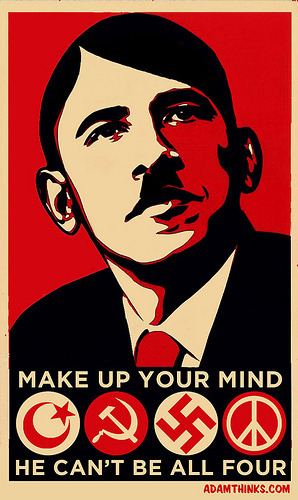
Lee Terry’s joke of the day

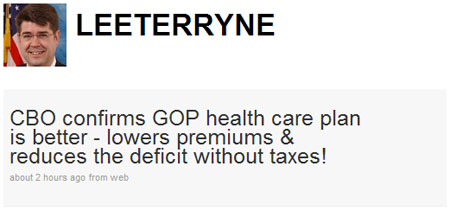
from Twitter:
Lee Terry congressional budget office CBO health care premiums deficit taxes
Here is a link to the actual CBO report: PDF.

Ezra Klein:

CBO begins with the baseline estimate that 17 percent of legal, non-elderly residents won’t have health-care insurance in 2010. In 2019, after 10 years of the Republican plan, CBO estimates that …17 percent of legal, non-elderly residents won’t have health-care insurance. The Republican alternative will have helped 3 million people secure coverage, which is barely keeping up with population growth. Compare that to the Democratic bill, which covers 36 million more people and cuts the uninsured population to 4 percent.

But maybe, you say, the Republican bill does a really good job cutting costs. According to CBO, the GOP’s alternative will shave $68 billion off the deficit in the next 10 years. The Democrats, CBO says, will slice $104 billion off the deficit.

The Democratic bill, in other words, covers 12 times as many people and saves $36 billion more than the Republican plan.

But Republicans argue they never sought to achieve universal coverage. They say their goal was to bring down costs. Matthew Yglesias points out that the CBO found these cost savings to be very meager (“the amendment would lower average insurance premiums in 2016 by zero to 3 percent”) and that the savings would be achieved by making coverage worse: Continue reading

Accidentally making the case for the public option

Today’s Lincoln Journal Star contains an editorial criticizing Harry Reid’s decision to move forward on a Senate healthcare bill with an opt-out public option. Aside from a puzzling analogy (the board claims an opt-out “would be akin to consciously deciding to stuff E. coli into the sausage links”), the editorial also relies on some contradictory logic.

While some of the board’s opposition comes from broader complaints about a public option in general, much of the criticism stems from what they call a potential “patchwork system” — they are concerned with problems that could arise from a scenario in which some states are participating in the public option and others aren’t.

“Opt-out decisions from Arizona and Texas alone would remove more than 30 million people from the public system,” the board argues.¹ “Would people with serious medical problems be tempted to move from opt-out states to those that offer the public option?” they ask.

Nevermind that they are simultaneously arguing against a public option while also acknowledging its necessity for people with “serious medical problems” — the editorial’s whole argument against the opt-out is a setup for the board to proclaim the superiority of a “trigger” system, favored by Olympia Snowe and Ben Nelson, which the LJS also endorsed in a July editorial.

For those unfamiliar with Snowe’s trigger, you can find it on page 207 of the Senate Finance Committee’s amendments (PDF): Continue reading

A plea to the holdouts

from Eschaton:

Dear fence-sitters (aka Lieberman, Nelson, Landrieu et al),

Forget all the talk about the public option for a second and ignore your political consultants who are cautioning you about the imaginary negative repercussions of a “government takeover.” The reality is this debate really isn’t about politics, it’s about health care. It’s not left or right, it’s about all of us.

People need help. They can’t afford their health care bills. People are dying. The crazy health care expenses are hurting businesses. Please don’t turn your back on these people. If you join with the Republicans and block health care reform, you’re basically saying to the American people – go f*** yourselves.

h/t DougJ

My 24 Hour Comic

Sorry the posting has been pretty sparse here lately. I’ll try to get caught up this weekend, posting a few overdue cartoons and the Top 10 Rejects of September.

But in the meantime, I’d like to share my 24 Hour Comic with you. I participated in the international writing and drawing event again this year, and you can view my creation HERE. I had a lot of fun again, and thanks to the kind people at Krypton Comics for hosting the event again this past weekend.

You can also check out last year’s comic HERE.

In honor of this weekend…

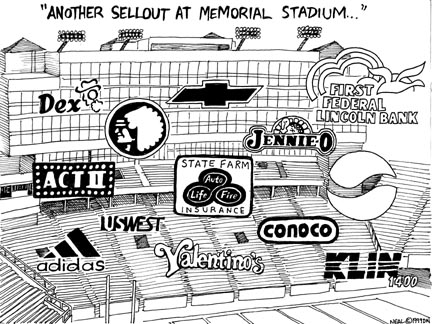
Please enjoy this gem from ten years ago.

I remember walking to the stadium and sitting up in the southeast corner of the stands to do the main drawing. I wrote down all the sponsors and advertisers I could see while I was there, and then I went back to the Daily Nebraskan office and looked for their logos in the Yellow Pages to finish the art.

This was clearly before the days of google image search.

Ben Nelson on All Things Considered today

A friend called me earlier this evening after having listened to Ben Nelson on today’s edition of All Things Considered on NPR. He alerted me to this exchange:

ROBERT SIEGEL: When you spoke of the extension of coverage, do you mean by that that you support in principle the idea of mandates, and that individuals and employers be required to purchase health insurance?

BEN NELSON: Well I think it’s important that it be compulsory. I don’t particularly like the idea of calling it a mandate. We have compulsory auto liability coverage in America today in virtually every state.

SIEGEL: Is there any more than a semantic distinction between something that’s compulsory and something that’s mandated?

NELSON: Well let’s put it this way — we already have a word that outlines exactly what it is and why it exists. Why do we invent new words?

To me, understanding that this is essentially an insurance issue is important to get away from the idea that there’s too much government involvement in it. We already have that kind of government involvement in mandating compulsory auto insurance. Why don’t we talk about it the same way so that people understand, “Oh, it’s just about like that.” Then you get away from all the discussions and the arguments about whether it’s too much government or not.

On first listen, I had pretty much the same reaction my friend did — Ben Nelson was caught trying to do a little linguistic dance. And when he was called out on it, he kept doing it rather than just fessing up to it, ultimately just coming off as kind of shifty and dishonest. But when I re-listened to see if I wanted to type anything up for the blog, I realized what Nelson is trying to do. I don’t think he handled the exchange very well, but I actually agree with his point and think it’s a smart move. Continue reading