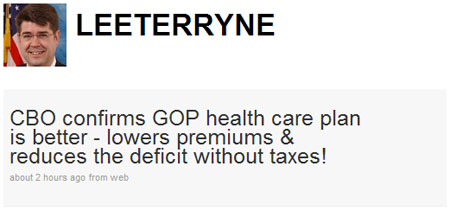
from Twitter:
Here is a link to the actual CBO report: PDF.
CBO begins with the baseline estimate that 17 percent of legal, non-elderly residents won’t have health-care insurance in 2010. In 2019, after 10 years of the Republican plan, CBO estimates that …17 percent of legal, non-elderly residents won’t have health-care insurance. The Republican alternative will have helped 3 million people secure coverage, which is barely keeping up with population growth. Compare that to the Democratic bill, which covers 36 million more people and cuts the uninsured population to 4 percent.But maybe, you say, the Republican bill does a really good job cutting costs. According to CBO, the GOP’s alternative will shave $68 billion off the deficit in the next 10 years. The Democrats, CBO says, will slice $104 billion off the deficit.
The Democratic bill, in other words, covers 12 times as many people and saves $36 billion more than the Republican plan.
But Republicans argue they never sought to achieve universal coverage. They say their goal was to bring down costs. Matthew Yglesias points out that the CBO found these cost savings to be very meager (“the amendment would lower average insurance premiums in 2016 by zero to 3 percent”) and that the savings would be achieved by making coverage worse: (emphasis his)
The second source of change in average insurance premiums is changes in the average extent of coverage purchased. Those changes can reflect both changes in the scope of insurance coverage—the benefits or services that are included—and changes in the share of costs for covered services paid by the insurer—known as the “actuarial value.” With other factors held equal, insurance policies that cover more benefits or services or have smaller copayments or deductibles have higher premiums, while policies that cover fewer benefits or services or have larger copayments or deductibles have lower premiums. Provisions in the amendment that would reduce insurance premiums by affecting the amount of coverage purchased include the State Innovations program, which would encourage states to reduce the number and extent of benefit mandates that they impose, and provisions that would allow individuals or affiliated groups to purchase insurance policies in other states that have less stringent mandates.
So to review, the CBO found that the Republicans’ bill would:
- Cover 36 million fewer people than the Democrats’ bill
- Reduce the deficit by $36 billion less than the Democrats’ bill
- Lower the premiums of 80 percent of the American workforce from zero to three percent by reducing their coverage.
And Lee Terry says the CBO confirms the Republicans’ plan is better.
Lee Terry is an idiot. For the life of me, I cannot understand why people vote for that dolt. He looks like the kid that everyone wanted to beat up because he was always kissing up to the teacher and then, when she wasn’t looking, sucker-punching guys in the nuts.
What’s worse, like his obnoxious father, he manages to sound offended (and offensive) when anyone tries to point out that what he’s saying is hogwash.
The 2nd District was smart enough to vote for Obama but not smart enough to bounce Junior from office. As Cubs fans say, “Maybe next year.”
Maybe it was a typo, and he meant to say that the CBO confirms the GOP health plan is batter. Or bitter. Or butter.
None of those really make any sense, but I’d probably take “gibberish” over “completely wrong.”
From the CBO letter to Rep Boehner
- The analysis does not take into account all of the proposal’s effects on spending for other federal programs or the administrative costs for oversight and implementation. In addition, the estimates address the amendment’s impact on direct spending and revenues but do not include the potential costs of provisions that would be subject to future appropriations or that would affect programs that are subject to future appropriations. -
It’s not all gum drops and hand jobs. Both parties release numbers, both parties accuse the other of lying about the numbers, both parties are technically, by the definition provided by the CBO, telling the truth, but in reality they are both full of shit. So while the Democrats may cover more people in their bill, it’s going to cost more than the 1.2 trillion they are touting around.