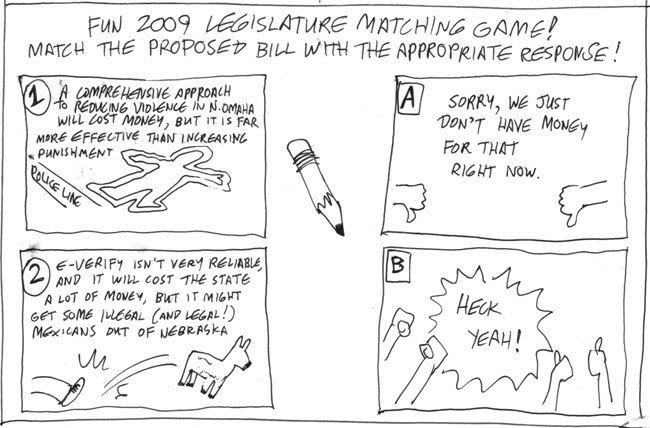
More than just jobs

from the Center for American Progress:

The consequences of this lower job creation go beyond the immediate impact of the recovery plan to the labor market. The recovery and reinvestment legislation as passed by the House was designed not just to create jobs through spending but also to put the economy on an upward trajectory where the private sector is once again creating jobs without the aid of intensive government intervention. The compromise necessitated by conservative influence in the Senate weakens the ability of the package to achieve that aim.

Krugman vs. Nelson

from yesterday:

What do you call someone who eliminates hundreds of thousands of American jobs, deprives millions of adequate health care and nutrition, undermines schools, but offers a $15,000 bonus to affluent people who flip their houses?

A proud centrist. For that is what the senators who ended up calling the tune on the stimulus bill just accomplished.
[…]
All in all, more than $80 billion was cut from the plan, with the great bulk of those cuts falling on precisely the measures that would do the most to reduce the depth and pain of this slump.

Krugman also puts the DeMint price tag at $3 trillion, which was the “conservative” alternative to so-called big spending and big deficits.

Job loss vs. Nelson

from Swampland:

Meanwhile, Ben Nelson is out gutting the stimulus of the most stimulative spending. So if you’re on that green curve up there, don’t worry — there might not be enough money for food stamps or unemployment insurance, but you’ll get a nice fat tax break if you want to buy a new house.

UPDATE: For some real doom and gloom, check out Paul Krugman’s latest blog, “What the centrists have wrought.”

The short answer: to appease the centrists, a plan that was already too small and too focused on ineffective tax cuts has been made significantly smaller, and even more focused on tax cuts.
[…]
Now the centrists have shaved off $86 billion in spending — much of it among the most effective and most needed parts of the plan. In particular, aid to state governments, which are in desperate straits, is both fast — because it prevents spending cuts rather than having to start up new projects — and effective, because it would in fact be spent; plus state and local governments are cutting back on essentials, so the social value of this spending would be high. But in the name of mighty centrism, $40 billion of that aid has been cut out.

My first cut says that the changes to the Senate bill will ensure that we have at least 600,000 fewer Americans employed over the next two years.

The real question now is whether Obama will be able to come back for more once it’s clear that the plan is way inadequate. My guess is no. This is really, really bad.

WaPo’s Pearlstein unloads on Nebraska’s senators

Take it away, Steve:

“This is not a stimulus plan, it’s a spending plan,” Nebraska’s freshman senator, Mike Johanns (R), said Wednesday in a maiden floor speech full of budget-balancing orthodoxy that would have made Herbert Hoover proud. The stimulus bill, he declared, “won’t create the promised jobs. It won’t activate our economy.”

Johanns was too busy yesterday to explain this radical departure from standard theory and practice. Where does the senator think the $800 billion will go? Down a rabbit hole? Even if the entire sum were to be stolen by federal employees and spent entirely on fast cars, fancy homes, gambling junkets and fancy clothes, it would still be an $800 billion increase in the demand for goods and services — a pretty good working definition for economic stimulus. The only question is whether spending it on other things would create more long-term value, which it almost certainly would.

Meanwhile, Nebraska’s other senator, Ben Nelson (D), was heading up a centrist group that was determined to cut $100 billion from the stimulus bill. Among his targets: $1.1 billion for health-care research into what is cost-effective and what is not. An aide explained that, in the senator’s opinion, there is “some spending that was more stimulative than other kinds of spending.”

Oh really? I’m sure they’d love to have a presentation on that at the next meeting of the American Economic Association. Maybe the senator could use that opportunity to explain why a dollar spent by the government, or government contractor, to hire doctors, statisticians and software programmers is less stimulative than a dollar spent on hiring civil engineers and bulldozer operators and guys waving orange flags to build highways, which is what the senator says he prefers.

Ben Nelson versus the stimulus, continued

In a follow-up from the update in yesterday’s post, it turns out the Ben Nelson gang wants to cut state aid after all, only it’s to the tune of $40 billion, not $25 billion. How direct aid to states with budget problems doesn’t qualify as stimulus to these people is beyond me. Out of one corner of their mouths, they say everything in the bill has to create jobs, yet then they turn around and support the home buying amendment, dishonestly billed at $19 billion when its actual price will be $75 billion to $375 billion.

The mock outrage exhibited by Republicans is pathetic, and good for Boxer for calling them out.

Moments later, Senator Barbara Boxer, Democrat of California, interrupted Mr. Graham saying she wanted to ask a question, but in fact she wanted to chastise him for waving around a copy of the bill. “Theatrical,” she exclaimed. “Did you do that when George Bush was president and he sent down a bill twice as big as that? Did you ever do that? You can do that. That’s theatrics. You can do that.”

The answer, of course, is no. Deficit spending and rapidly expanding debt is apparently totally fine for Republicans and Ben Nelsons as long as there’s no reason for it.

There’s a growing momentum against the stimulus among conservative pundits who argue that there’s no evidence the stimulus will work. This, of course, ignores the evidence (Republicans were all about touting the CBO report when it wasn’t real, but now that it is real, it suddenly doesn’t exist to them). I have no problem with someone saying the evidence doesn’t convince them that spending will work. That leads to discussion and so on. What does make me question their motivations and their openness to being convinced, is when they turn around and say we need to eliminate spending and alternatively implement hundreds of billions of dollars in tax cuts for the rich. Evidence of success is apparently not required for that tactic.

Johanns for the rich at everyone else’s expense

Not that anyone would be surprised, but Mike Johanns voted for Sen. Jim DeMint’s “stimulus” bill, summarized here by David Weigel at the Washington Independent:

• Permanently repeal the alternative minimum tax once and for all;
• Permanently keep the capital gains and dividends taxes at 15 percent;
• Permanently kill the Death Tax for estates under $5 million, and cut the tax rate to 15 percent for those above;
• Permanently extend the $1,000-per-child tax credit;
• Permanently repeal the marriage tax penalty;
• Permanently simplify itemized deductions to include only home mortgage interest and charitable contributions.
• Lower top marginal income rates from 35 percent to 25 percent.
• Simplify the tax code to include only two other brackets, 15 and 10 percent.
• Lower corporate tax rate as well, from 35 percent to 25 percent.

What goes unstated here is that when you “simplify” the tax code to include fewer brackets, you’re going to end up increasing taxes on poor and middle class people who are moved into a larger bracket. So this is not only a tax break for the rich, it’s a tax increase for many poor and middle class families.

I would really like someone to explain to me how you can depend on supply side economics to fix a recession caused by a $2.7 trillion demand deficit. Critics of the stimulus argue that we really don’t have a similar historical model on which to judge how government spending would help fix this situation. Let’s, for a second, assume that to be true. If the alternate proposal is to rely on trickle-down economics, which it is, we actually have a pretty recent example in which $2 trillion in tax cuts, largely for the rich, not only failed to stimulate the economy, but led to an economic downturn: that would be right now.

UPDATE: Here is a PDF released by the White House that lists a state-by-state breakdown of funding. On the topic of state benefits from the stimulus package, it should be noted that Ben Nelson has been attached to an effort to strip nearly $25 billion in state stabilization funds from the package, although now he appears to be backing off.

Wow

As if the politics-before-policy games weren’t transparent enough with House Republicans, they’ve now invited Joe the Plumber, a.k.a. Sam the not-plumber, to advise them on economic policy.

Wurzelbacher, who became a household name during the presidential election, will be focusing his talk on the proposed stimulus package. He’s apparently not a fan of the economic rescue package, according to members of the group.

You’d think there’d be a better way to hide the fact you can’t get any real economists to support you. As Steve Benen said, “Once in a while, I get the sense Republicans on Capitol Hill want to be made fun of… The line between Republicans’ approach to governing and satirical performance art blurs just a little more.”

h/t: Brian Beutler @ Thinkprogress