Mo’bility

If I did everything correctly, this site should now be optimized for mobile browsers. I do not, however, have a mobile device with a web browser, so I have no way of testing it.

If you are visiting this site with a mobile device, please let me know 1) if you notice any changes, and 2) if the changes make it better or worse.

Thanks.

Blogging in San Diego

One of the new features of SanDiegoReader.com is the staff blogs, and I am excited to announce that as of today, I’m part of it.

Obermeyer’s Cut is the working title for my Reader blogging home (suggestions for an alternate name are welcome). While much of the content I post there will have the potential to be duplicated here, blogs I post here tend to be more focused on Nebraska news and media, and there obviously won’t be any of that there.

So be sure to check out my first post, 3 Trends Most Likely to Impact Cartoons – it’ll lead you to a great new Daily Cartoonist article.

Using the skills I learned in advertising distribution school…

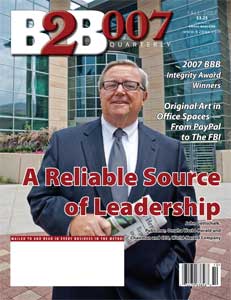
Check out the fall issue of B2B Quarterly for a profile on John “Workhorse” Gottschalk, publisher of the Omaha World-Herald.

One of my favorite quotes:

Also, [Gottschalk] says, the World Herald is not in the newspaper business. “We’re in the advertising distribution business.”

He goes on to talk about how if you only report the news you want to report, instead of reporting the news that affects your readers, your readers will leave you.

So I checked up on the past few years of the Omaha World-Herald’s circulation:

year – daily / Sunday

2004 – 195,964 / 242,018
2005 – 194,222 / 240,026
2006 – 188,866 / 231,115
2007 – 184,150 / 222,469

That’s a drop of more than 10,000 daily readers and almost 20,000 Sunday readers in just three years. (In fairness to the World-Herald, though, many other papers lost significantly more, and the OWH actually climbed from 55th highest circulation in the US to 51st over that same time period.)

The article is also full of horse metaphors, including references to workhorses, showhorses, thoroughbreds and pedigree.
Cartoons in the Classroom

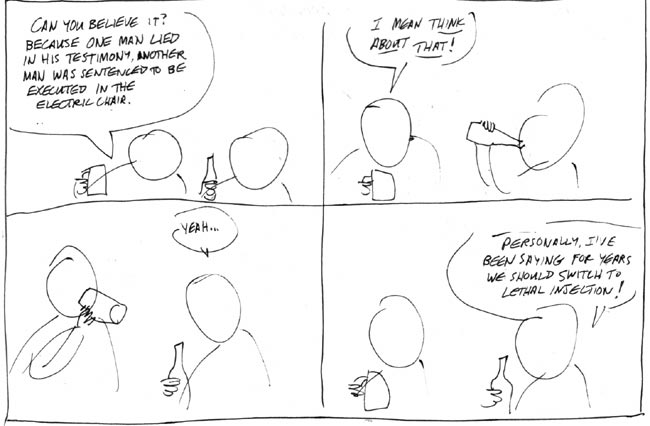
Newspapers in Education and the Association of American Editorial Cartoonists provide a fortnightly lesson on editorial cartoons entitled Cartoons in the Classroom.

The series takes a look at several cartoons and educates students on the literacy of cartooning – how to read, dissect and analyze the symbolism and underlining meaning of cartoons, often drawing attention to differing conclusions.

Even though I’m long past the target age, I still think it’s fun to look at the lessons and see how what we do can be viewed in so many different ways from different eyes (and I just realized that my blog entry about Koterba’s and Cagle’s Barry Bonds cartoons was mentioned in the latest lesson).

Arnold Wagner

Arnold Wagner has passed away. He’d been battling cancer for quite some time, and it had recently returned. His daughter announced the news late Friday night.

I never knew Arnold in person, but I consider myself very fortunate to have interacted with him online over the past several months.

I met him at the toontalk forums, where he came across as this wise and gentle grandfatherly figure, always willing to share advice and insight. His blog, Arnold’s Cartoonology, is a treasure of cartoon history. The formatting has gone a bit wacky in recent months, but if you can handle it, it’s definitely worth reading.

It was a treat to get to know him, even if it was only in the limited way that I did.

Thanks, Arnold.

Seeking bias

In this week’s Caf?© San Diego at voiceofsandiego.org, guest host Gayle Lynn Falkenthal, president of Falcon Valley Group, writes about blogging and media bias.

Some points that jumped out at me:

It‚Äôs a funny thing to me. The public complains about biased reporting … and then seeks out information full of nothing BUT bias on blogs and web sites of unknown origin.

How true. But she continues:

The best citizen journalism follows the best practices of good mainstream journalism: It’s sourced, it’s factual, and there’s a byline from a real person.

It made me think about the blogs I visit on a regular basis and who is not afraid to be up front about who they are, and who hides behind a veil of anonymity. Some obviously need to protect their identity, while it seems others are just comfortable to take cheap shots from the dark.

You can check out more of Falkenthal’s guest host stint, as well as previous hosts, at Caf?© San Diego.

Paul Fell, resurfaced

I have no idea where to pick up Prairie Fire, the new alternative weekly / monthly (I’m not sure) newspaper, but I’d heard word that Paul Fell had a column about editorial cartooning.

Also, after several weeks of no new content, I’d concluded that they were just not updating their website. I’ve continued to search fruitlessly to find a hard copy, so I pulled up the site today to see if there was info on where to find the paper, only to discover they have in fact updated the site and are leading with Paul Fell’s column (and cartoon).”

Entitled ‘The State of Editorial Cartooning,’ there’s little new ground covered if you’ve been following this site or any other commentary on the state of cartooning, but it’s still worth a read if you’d like a local perspective.

World-Herald changes facts in letters

But it’s okay, because it doesn’t make the war sound as bad.

Over at the New Nebraska Network, Don Kuhns shares a letter he wrote in which the World Herald’s editors changed data on the cost of the Iraq war:

The editing job you did on my last letter contained an error that cannot be ignored. The sentence you altered was this:

“According to the Congressional Research Service, we now spend approximately $328 million per day in Iraq.”

You changed that factual statement into this false statement:

“We are spending tens of millions of dollars daily on Iraq.”

Since when is it the job of an editor to change a completely reasonable, accurate, and easily verifiable statement into one that is demonstrably false?

I could understand wanting to perhaps adjust a hyperbolic account of spending to something more precise and verifiable, but Kuhns obviously started out precise and cited his source.