The Bonds that Bind

This past April, after the Virginia Tech shootings, some friends and I were discussing the way the media handled the situation. One of those discussions turned to the editorial cartoonists’ response, which I have written about here before. Just from Daryl Cagle’s cartoon syndicate website, one could find several cartoons changing the “VT” logo into a pistol; several more depicting Uncle Sam mourning; two very similar cartoons with a parent hugging a child who thought his parent would be happy he got in to college; and a few with the Virginia Tech mascot mourning in Uncle Sam’s place.

Friends outside of cartooning were shocked when I assembled a handful of cartoons and exposed the similarities side by side. One told me that it was obvious to him that these cartoonists were copying each other, but I argued that couldn’t have been the case when so many of these came out on the same day.

So I opened my copy of the Omaha World-Herald this morning to see Jeff Koterba’s cartoon on Barry Bonds. It involved Bonds swinging and missing at a pitched asterisk instead of a baseball. I immediately recalled Daryl Cagle’s cartoon of two weeks ago, which depicted Bonds connecting with an asterisk instead of a baseball.

Now in my never-ending quest to be as critical as possible and burn every cartooning bridge before it’s assembled, I was tempted to go on one of my customary rants about cartoonist groupthink killing off the industry, blah blah blah, but I thought I’d try something different and turn to the humans behind the cartoons to get their side of the story.
Continue reading

A rejected cartoon I really liked

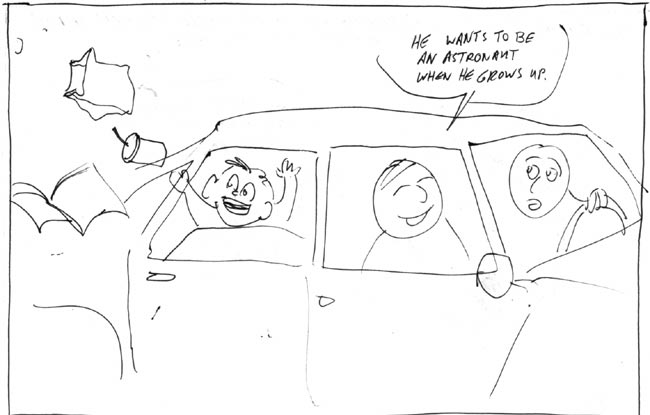
This sketch did the rounds at the Journal Star and the Omaha Reader, but nobody bit, even though I really wanted it to run.

Nebraska’s own astronaut, Clayton Anderson, was the star of several news stories the past week or so, since he’s the first Nebraskan to get shot up into space. One of Clayton’s big duties, as detailed in many of the stories, was to take some junk from the station and toss it out into space, where it would join the existing debris in that great landfill in the sky.

Maybe it was too easy, but I just loved the look of joy on the kid’s face as he littered his Happy Meal.

Draw me a river

Alan Gardner at Daily Cartoonist writes about cartoonists’ self-proclaimed status as an ‘endangered species’:

When I wrote last week that today’s editorial cartoonists are ‘infatuated by their own victim status’ this is an example of what I mean. It’s becoming an incessant whine that their profession is in decline – but it’s been that way for over 50 years and I’m starting to gloss over on the message. It’s not new, and it doesn’t tell me (if I was a newspaper editor) why in this changing environment I should keep the cartoonist other than to continue the grand tradition.

I posted a flippant response, asking

Quick question: are there more

1. Cartoonists giving speeches and writing articles about how editorial cartoons are an essential and irreplaceable form of political discourse, or

2. Cartoonists drawing interchangeable cartoons starring a few dogs wisecracking about Michael Vick?

I chose the wrong Michael Vick Standard to mock, but honestly, if you were Drew Sheneman’s editor at the Newark Star Ledger, Mark Streeter’s editor at the Savannah Morning News or Gary Varvel’s editor at the Indianapolis Star-News, how special would you feel that you have a staff cartoonist who turned in almost the exact same cartoon that any other newspaper in the country could have plucked off the syndicate?

I’m still not sure why all these cartoonists even made Michael Vick cartoons. I mean, sure, it was all over the news, but do we really need a cartoonist’s unique perspective to say illegal dogfighting is bad?

It seems many cartoonists today would much rather give speeches or write passionate journal articles about the endangered status of the industry. But in this case, a picture would be far more effective than the thousands words wasted on the topic. Rather than rushing to make yourselves irrelevant, prove that you deserve that page space more than a syndicated cartoon.

Glenn Beck’s conspiracy theory

I found myself listening to Glenn Beck’s program today, and he was speaking with the mayor of some town on the problems brought about by illegal immigration.
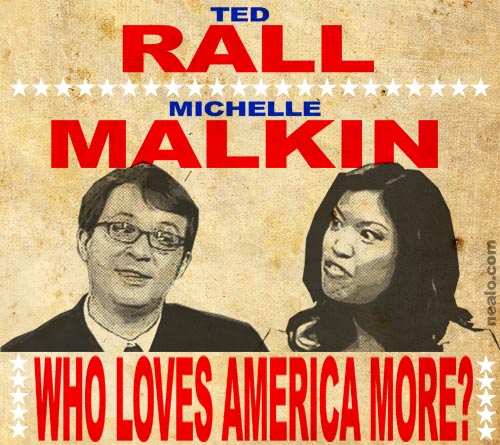
At the beginning of what I heard, he was coming at his opposition from a compassionate perspective: the way illegal immigrants are being treated is like modern day slavery – horrible working conditions, horrible living conditions, horrible pay. So what does this compassionate man advocate for a solution? Criminalizing them and deporting them, basically. It’s a nice new angle to take, hiding xenophobia behind a veil of concern. But it gets way better.
Continue reading

The origin of “Compassionate Conservative”

from bradblog.com:

Team Bush began describing candidate George W. Bush as a ‚Äúcompassionate conservative‚Äù in 1998, when Bush began his open run for president, as opposed to the behind-the-scenes operation that had begun with his first run for governor of Texas in 1994. By the time the 2000 presidential campaign was in full swing, probably every American with a television had heard the label. In fact, as the actual election approached, the Bush campaign often took to preferring ‚Äúreformer with results‚Äù — reacting to a margin of diminishing returns for ‚Äúcompassionate conservative.‚Äù

Where did they get the “compassionate conservative” label? Hardly anyone would remember or notice in 1998, but the New York Times had run it front-page on August 7, 1978, when Pope Paul VI died and the Times ran his photograph, captioned prominently as a “Compassionate Conservative,” above the fold. Originally the phrase was a genuine tribute to honor a man who by all accounts deserved it. Its recycling by the Bush campaign was a tactic designed to help Bush seem ‘centrist.’

The golden ticket

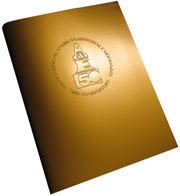
I got my copy of the Association of American Editorial Cartoonists’ “Golden Notebook” in the mail today. It’s the 50th anniversary of the organization’s newsletter, and if you have any interest in the world of editorial cartooning, you need to find a way to get your hands on it. Editor & Publisher claims the book will be made available for sale to the public, but I’ve looked all over the AAEC’s site for a link and I can’t find anything. (My copy was sent to me for some reason – I’m not a member, so maybe it was a review copy?)

While it is built around a history of the AAEC, no history of a cartoonists’ organization would be useful without the relevant context providing a backdrop, and thus the AAEC’s history ends up becoming a history of American editorial cartooning for the past 50 years.

There’s a lot of stuff that will be pretty meaningless to anyone who doesn’t care about who the officers have been throughout the years or what the admission to the convention was 30 years ago (there’s a Paul Fell sighting on page 81), but there are also some reprints of classic articles like “The Rise and Fall of the Political Cartoon” by Henry Ladd Smith from the May 29, 1954 issue of the Saturday Review and “Why Political Cartoonists Sell Out” by Lee Judge and Richard Samuel West from the September 1988 issue of The Washington Monthly.

The book is in no way a simple glorification of its members – one of my favorite articles is “Editorial Cartoonists & 9/11,” subtitled “A cliche’s high-water mark, or, Liberty wept.” It includes quotes from cartoonists’ discussing the onslaught of cartoons depicting the Statue of Liberty crying in the aftermath, including some damning statements like this one from Ted Rall: “The problem is…the Statue of Liberty crying, with a hole in her chest or with a model airplane smashing into her side only conveys one concept: Lazy Editorial Cartoonist.” (More quotes from the discussion can be found on the AAEC’s website on this page)

I unfortunately have no idea how much this thing costs, but someone at The AAEC should be able to help.