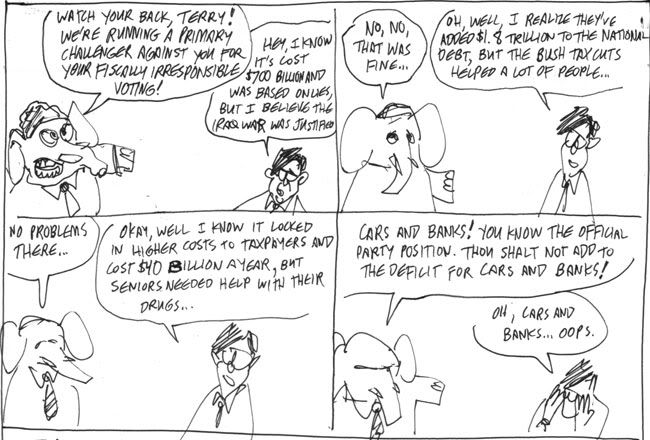
from the Lincoln Journal Star
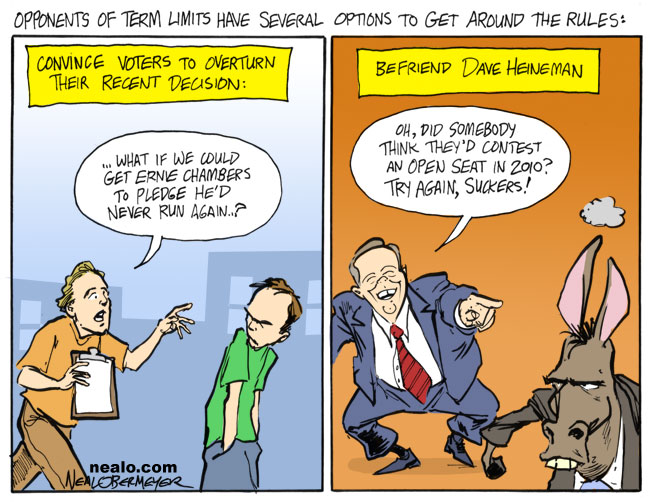
from the Lincoln Journal Star
I got blasted in two letters this week for this cartoon:
I thought Neal Obermeyer’s editorial cartoon (LJS, Aug. 10) was in especially poor taste, and you should not have run it. Regardless of how you feel about the topic of abortion (in any form), referring to the ruthless murder of Dr. Tiller as a “hint” condones lawless behavior and insults Tiller’s survivors.
The editorial page may be wide open, and I support your right to free speech, but that right comes with some social responsibility and you failed to show any restraint. Shame on you.
Mark Forster, Lincoln
I must take strong exception to the Neal Obermeyer cartoon published in the Aug. 10 Journal Star. To label the slaying of Dr. George Tiller a “hint” is an affront to those on both sides of the right-to-life question who believe in the rule of law in this country, and suggests Obermeyer’s approval of the accused killer’s actions. The gunning down of Tiller in a church was a cold and cowardly act of murder – nothing less. To call it anything else insults all people of faith who believe there are no exceptions to the sixth commandment.
Alexander Currie, Lincoln
The murder of Dr. Tiller was clearly supposed to send a message to other doctors that continuing to perform these services will put a target on your head. Threats of violence are inexcusable. What I was attempting to do with the cartoon was expose the awfulness of this reality by putting it in a sort of silly, flippant context (sort of like in previous cartoons like this and this), juxtaposing something serious with something truly mundane in hopes that the contrast would emphasize the vileness of the situation. I clearly failed.
Enjoy this online comic about the healthcare bills so far. I got a kick out of Wax-Man, and I’m admittedly anxious to see what happens…
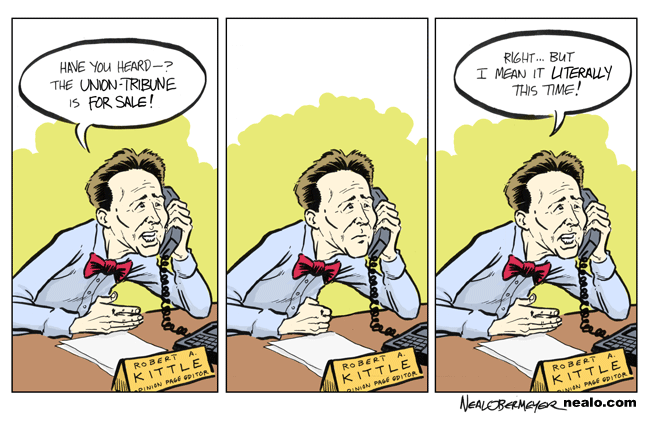
Voice of San Diego’s Rob Davis describes Kittle’s legacy as the Union-Tribune‘s former editorial page editor:
“He was very liberal with the facts,” [Councilmember and former mayoral candidate Donna] Frye said. “And had a great disregard for truth. Name-calling goes with the territory. That doesn’t bother me. But what bothered me was the absolute lack of factual information. When facts are deliberately tortured, that’s not ethical journalism.”
More recently, Kittle engaged in few battles that were as vitriolic as his fight with Mike Aguirre, the former city attorney. The irony in their sometimes petulant squabbles: Kittle had endorsed Aguirre in 2004. That was a short romance.
They clashed over pension issues. They clashed over Sanders’ proposed reforms. And as in many knock-down fights, they clashed over the irrelevant, such an Aguirre aide’s use of foul language. Aguirre eventually started his own blog, largely dedicated to refuting Kittle editorials.
One 2007 editorial accused Aguirre of violating campaign finance laws. The local Republican Party jumped on the news. GOP officials marched into the City Clerk’s Office — TV cameras watching closely — to file an ethics complaint against Aguirre.
But the editorial’s accusation was baseless.
from the Omaha Reader
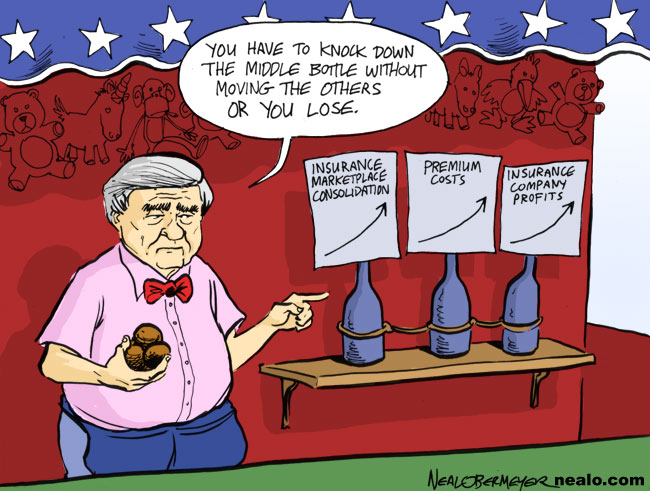
Sen. Lisa Murkowski (R-AK), who opposes the House and Senate health care bills:
“It does us no good to incite fear in people by saying that there’s these end-of-life provisions, these death panels,” Murkowski, a Republican, said. “Quite honestly, I’m so offended at that terminology because it absolutely isn’t (in the bill). There is no reason to gin up fear in the American public by saying things that are not included in the bill.”
Sen. Chuck Grassley (R-IA), considered by folks like Ben Nelson, Max Baucus, Kent Conrad and Barack Obama to be a good-faith negotiator and key player in the quest to develop a bipartisan health compromise:
“There is some fear because in the House bill, there is counseling for end-of-life,” Grassley said. “And from that standpoint, you have every right to fear. […] We should not have a government program that determines if you’re going to pull the plug on grandma.”
from the Lincoln Journal Star
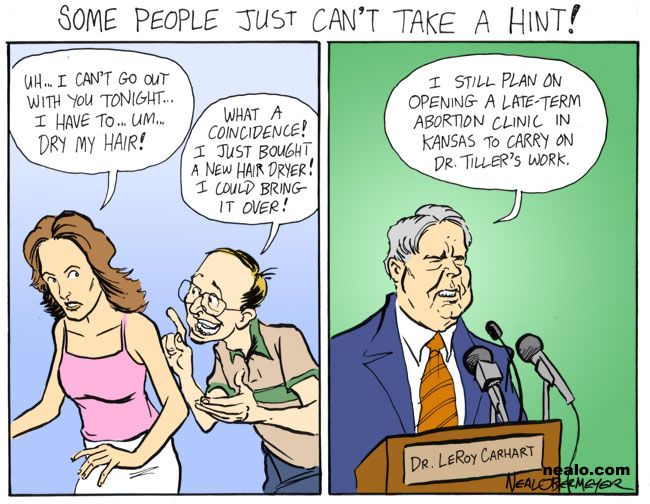
Here’s hoping Carhart fares better than Tiller.
Heavy on the healthcare this month, but that’s to be expected when you can’t read the local news without seeing Ben Nelson making another stupid comment sticking up for the poor endangered insurance industry. I think he’s looking out for me, making sure I keep cranking out the angry doodles.
10.
The results of a recent Gallup survey showing Nebraska shifting from “lean Republican” to “competitive” have generated some discussion, particularly centered around the surprising percentages of Nebraskan who claim to favor Democrats and those who favor Republicans.
Here’s a comparison between the poll results, 2008 voter registration numbers and 2008 presidential election results:
Gallup survey results:
Respondents favoring Democrats: 43%
Respondents favoring Republicans: 42%
Neither / other: 15%2008 Voter Registration:
Democrats: 34% (393,468)
Republicans: 49% (558,308)
Independents: 17% (195,459)2008 Presidential Election Results:
Barack Obama: 42% (333,319)
John McCain: 57% (452,979)
Naturally, as outlined in Don Walton’s Journal Star story, different sides are going to have different reactions to these results, but all of the response I’ve seen seems to focus on the surge in Democrats’ numbers — whether they’re a sign of a shift in Nebraskans’ attitudes or an already-outdated relic of post-election enthusiasm. For example, there’s this recent post at Lincolnite.com, in which Mr. Wilson said
The data come from the first six months of 2009. The first few months of that period were marked by heavy Obamaphilia; skepticism and cynicism are now setting in. I suspect data from the second half of 2009 won’t be quite as favorable.
In the discussion about the accuracy of the apparent nine percent gain for Democrats, no one seems to be mentioning that there is a near inverse seven percent drop for Republicans. I can see Obama enthusiasm pulling self-identifiers from the Independent / Other category to Democrats, which it may be doing, but notice that the Independent / Other breakdown between registration and self-identification is fairly steady (17% to 15%). The obvious assumption would be that seven percent of Republicans shifted to that “other” 15%, choosing to not identify themselves with their party, and I don’t think Obama enthusiasm can tell that whole story.
But let’s say Mr. Wilson (who echoes the thoughts of Republican Chairman Mark Fahleson) is correct, and the shift is temporary Obama enthusiasm. If that assessment is accurate, it would demonstrate a relationship between Obama approval and party identification that hasn’t existed nationally.
Continue reading