Nobody to call him ‘Benator’ anymore

Steve Benen on the Democrats who have taken up the Republican task of killing healthcare reform by delaying it:

It occurs to me, then, that there’s at least a possibility that “centrist” Democrats — Blue Dogs, New Democrats, Lieberman, et al — might not see failure as such a horrible option here. In other words, they may realize that coming up short on health care, letting this opportunity slip away, and hurting millions of Americans in the process may be devastating for the Democratic majority, but these same “centrist” Democrats may prefer a smaller majority, or perhaps even a GOP majority to “balance” the Democratic president. They may very well disagree with the party’s leadership on most issues, and think the best course of action is taking away their power by undermining the party’s agenda.

It seems odd that these “centrist” Democrats would forget the lessons of 1993 and 1994. But alternatively, are we sure they have forgotten those lessons, or have they learned those lessons all too well?

“The Six Deadly Hypocrites”

from Paul Krugman:

What’s especially galling is the hypocrisy of their claimed reason for delaying progress — concern about the fiscal burden. After all, in the past most of them have shown no concern at all for the nation’s long-term fiscal outlook.

Case in point: the Medicare Modernization Act of 2003, which denied Medicare the right to bargain for lower drug prices, locked in overpayments to private insurance companies, and did nothing, nothing at all, to pay for its proposed outlays. How many of these six self-proclaimed defenders of solvency voted no on the crucial procedural vote? One. (Joe Lieberman, to my surprise.)

And let’s not forget that Ben Nelson, who appears to be the ringleader, has fought tooth and nail against competition from a public option — which would almost certainly save a significant amount of money, as well as providing much-needed competition.

Ben Nelson, the Cautious Reformer

So Ben Nelson has drafted a letter and rounded up some buddies who have decided to slam the brakes on healthcare reform.

Never mind that Nelson has admitted his demands are incompatible, thus calling into question how serious he is about the prospect of supporting anything. There are real, human costs to delaying reform so that Ben and friends can go on vacation. From Jay Rosenbaum at Health Care for America NOW:

Just to put a fine point on it, over three weeks in America:

* 143,250 people will lose their health insurance coverage [pdf]
* 53,507 people will file for bankruptcy because they can’t pay their medical bills
* 1,265 people will die [pdf] because they lack coverage

An unusual display of intellectual honesty from Ben Nelson

from today’s Lincoln Journal Star:

Nelson said he wants to support a plan that reduces the cost of health care, raises the quality of care, expands choices and extends coverage to those who cannot attain it today.

When those elements are combined with his other concerns, Nelson said, “I don’t know if all of that’s possible.”

So Senator Nelson is at least admitting that he has created a scenario in which it’s impossible to meet his demands, and thus impossible to get his vote — not unlike other noisy Blue Dogs who fight savings measures and then complain about the cost. For example, he says he wants more competition, yet he still objects to a public insurance proposals out of fears of “how they might affect the current market.” So either way, he votes no.

Healthcare for America NOW’s report on the near-monopolies of the private health insurance industry pointed out just how little competition there is in that market. According to the U.S. Department of Justice,

When a firm has more than a 42 percent share of a single market, the U.S. Justice Department considers that market to be “highly concentrated.” This means that an insurer could raise premiums and/or reduce the variety of plans or quality of services offered to customers with impunity.

The study included state-by-state breakdowns (PDF), which showed that Blue Cross and Blue Shield has more than 44% of the Health Insurance market in Nebraska, followed by UnitedHealth Group at 25%. That’s 69% of the market controlled by two companies in a state that saw premium growth outpace income growth 69% to 21% from 2000 to 2007. This is the market that Ben Nelson is concerned about disrupting.

Ben Nelson can’t spel (or maybe he can’t count)

from the Washington Post (h/t Yglesias):

“Tax is a four-letter word” with voters, said Sen. Ben Nelson (D-Neb.).

And from Bloomberg (h/t NNN)

Senator Ben Nelson, a Nebraska Democrat, said he’s “not hearing a lot” of support for a surtax on wealthy Americans. People in his state don’t like the millionaire’s tax “because they are looking someday to get there themselves,” Nelson told reporters on July 13. “It’s the American way.”

Ben Nelson is no stranger to conducting imaginary polls of Nebraska opinions that conveniently line up with his predetermined conclusions. When I read of his latest fake survey, I couldn’t help but be reminded of this post from Ezra Klein during the stimulus debate:

Confronted with Krugman’s argument that Nelson’s cuts did not display “any coherent economic argument,” Nelson offered no coherent argument — economic or otherwise — in response. And this is the guy deciding the size of the stimulus package. He’s cutting 500,000 jobs from the stimulus based on some fake poll he mentally conducted of Nebraskan preferences. He doesn’t even bother to justify his actions on the merits. It’s appalling.

Jonathan Chat at The New Republic points out that ABC News and the Washington Post conducted a real poll, which found 60% of surveyed Americans would support raising income taxes on those with incomes above $250,000 to help pay for health care reform, while 37% were opposed.

But when the issue is that there will be a tax hike and the question is who should pay, why would a middle class person favor a middle-class tax hike on the grounds that they might one day be rich? Are there really people who think, “I’d rather take the hit now, and have less money for my kids’ college education, so that one day when I’m really rich I can have a lower tax burden and thus afford two BMW’s instead of one”?

It’s possible such people exist and have shared their thinking with Ben Nelson. On the other hand, perhaps the more likely possibility is that the people who Ben Nelson hears from are already in the top 1% right now.
Top 10 8 Rejects of the Month: June

I’m honestly not sure why I had so few sketches to choose from this month. I store these things chronologically and there’s a gap in the early part of June, yet I don’t remember taking two weeks off. Anyway, on with the countdown!

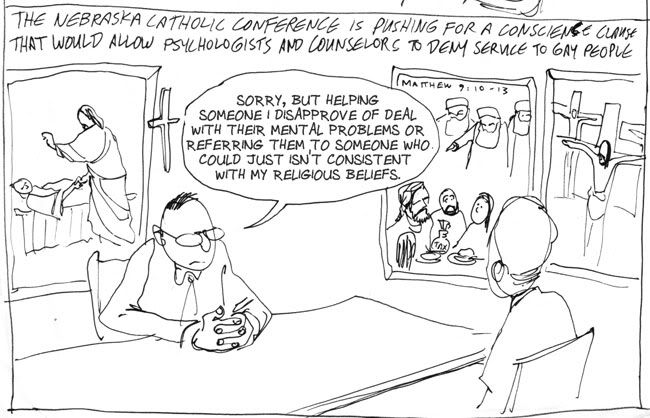
8. I’m actually kind of glad this one didn’t get picked. I like the idea — that not helping people simply because you find them objectionable is profoundly unchristian — but I was a little uncomfortable with the New Testament references. I thought they were essential to making the point of how hypocritical the Nebraska Catholic Conference was being, yet I think it could have been counterproductive to compare homosexuality to crimes and illnesses.

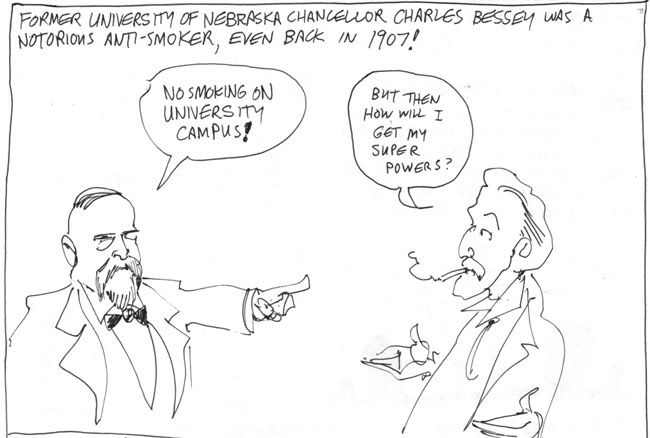
7. I don’t think anyone got this one, which is understandable. I was just trying to make a goofy joke off of how people had no idea what they were ingesting. Although I have no idea if he’s ever been a smoker, Thomas Spann was my inspiration for the guy on the right.

Continue reading