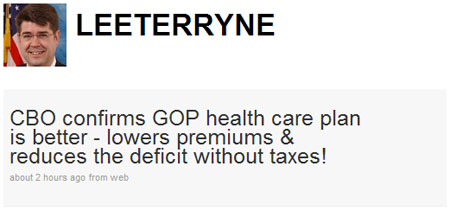
Lee Terry’s joke of the day

from Twitter:
Lee Terry congressional budget office CBO health care premiums deficit taxes
Here is a link to the actual CBO report: PDF.

Ezra Klein:

CBO begins with the baseline estimate that 17 percent of legal, non-elderly residents won’t have health-care insurance in 2010. In 2019, after 10 years of the Republican plan, CBO estimates that …17 percent of legal, non-elderly residents won’t have health-care insurance. The Republican alternative will have helped 3 million people secure coverage, which is barely keeping up with population growth. Compare that to the Democratic bill, which covers 36 million more people and cuts the uninsured population to 4 percent.

But maybe, you say, the Republican bill does a really good job cutting costs. According to CBO, the GOP’s alternative will shave $68 billion off the deficit in the next 10 years. The Democrats, CBO says, will slice $104 billion off the deficit.

The Democratic bill, in other words, covers 12 times as many people and saves $36 billion more than the Republican plan.

But Republicans argue they never sought to achieve universal coverage. They say their goal was to bring down costs. Matthew Yglesias points out that the CBO found these cost savings to be very meager (“the amendment would lower average insurance premiums in 2016 by zero to 3 percent”) and that the savings would be achieved by making coverage worse: Continue reading
Accidentally making the case for the public option

Today’s Lincoln Journal Star contains an editorial criticizing Harry Reid’s decision to move forward on a Senate healthcare bill with an opt-out public option. Aside from a puzzling analogy (the board claims an opt-out “would be akin to consciously deciding to stuff E. coli into the sausage links”), the editorial also relies on some contradictory logic.

While some of the board’s opposition comes from broader complaints about a public option in general, much of the criticism stems from what they call a potential “patchwork system” — they are concerned with problems that could arise from a scenario in which some states are participating in the public option and others aren’t.

“Opt-out decisions from Arizona and Texas alone would remove more than 30 million people from the public system,” the board argues.¹ “Would people with serious medical problems be tempted to move from opt-out states to those that offer the public option?” they ask.

Nevermind that they are simultaneously arguing against a public option while also acknowledging its necessity for people with “serious medical problems” — the editorial’s whole argument against the opt-out is a setup for the board to proclaim the superiority of a “trigger” system, favored by Olympia Snowe and Ben Nelson, which the LJS also endorsed in a July editorial.

For those unfamiliar with Snowe’s trigger, you can find it on page 207 of the Senate Finance Committee’s amendments (PDF): Continue reading